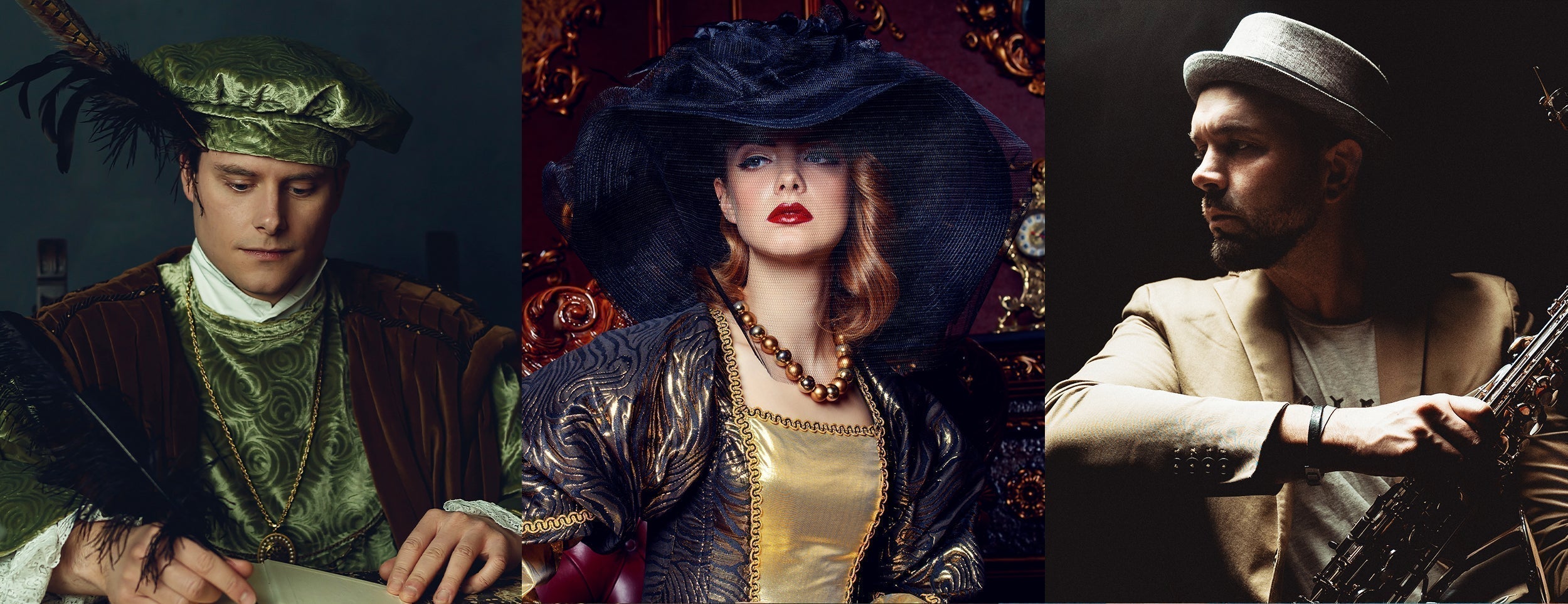
Welcome to Altenburger Hat & Costume, your tailor and hat maker from beautiful Thuringia. Are you interested in hats and would like a brief overview of the most important hat styles from the Middle Ages to modern times? In this article, we offer a glimpse into the fascinating history of hat design. Simply follow our timeline from the Middle Ages to the present day.
 Head coverings of the Middle Ages
♦ The cap

In the Middle Ages and even in antiquity , the term "cap" was a very general term for a variety of simple head coverings, often without a brim or with only a slight indication of one. It served all social classes as a practical and widespread hat that protected against cold, sun, and dirt.
Whether as a simple work cap or as a warming addition under helmets – the cap was a functional and indispensable item of clothing from the Early Middle Ages to the Late Middle Ages and thus the basis for all subsequent head coverings.
♦ The headscarf

The headscarf was an everyday and practical head covering in the Middle Ages and even in antiquity, especially among peasant women and women from the poorer classes.
It served to cover the hair, protecting it from dirt and sun, and was a simple but effective way to tame hair during work. The material and design were simple, usually made of linen or plain wool.
♦ The hat with a brim (floppy hat)

The wide-brimmed hat, made of straw or other materials, has been a perennial favorite since antiquity. Countless styles have been developed from it, and it remains popular to this day.
In the late Middle Ages, the floppy hat became widespread among the common people, as it offered perfect protection from the sun and weather. Brimmed hats were often made of felt, straw, or wool and could take on different shapes depending on the region and fashion.
♦ The pointed hat

The pointed cap is a cap with a characteristic, often pointed or conical tip (the "point"), which sometimes folds over or hangs down. Its origins date back to the Middle Ages and antiquity , where it served in various cultures as practical headwear for protection against the cold or as part of traditional costumes.
In the 19th and 20th centuries, the pointed cap gained particular popularity as a symbol of fairytale characters (e.g., dwarves, gnomes) and childhood. It is typically made of soft materials such as wool or felt and is worn today primarily during the colder months, at Carnival, or as part of traditional clothing.
♦ The Mitre

The mitre is a tall, two-winged headdress worn by bishops, abbots, and other high-ranking dignitaries of the Catholic, Orthodox, and some Protestant churches. Its characteristic form consists of two stiff, often pointed halves connected at the front and back by a band, as well as two hanging bands (fulms) at the nape of the neck.
The mitre has been used as a liturgical headdress since the 11th century and developed from the Byzantine tradition. It symbolizes the dignity and authority of the wearer in his office and is worn during solemn church services and ceremonies.
♦ The fool's cap

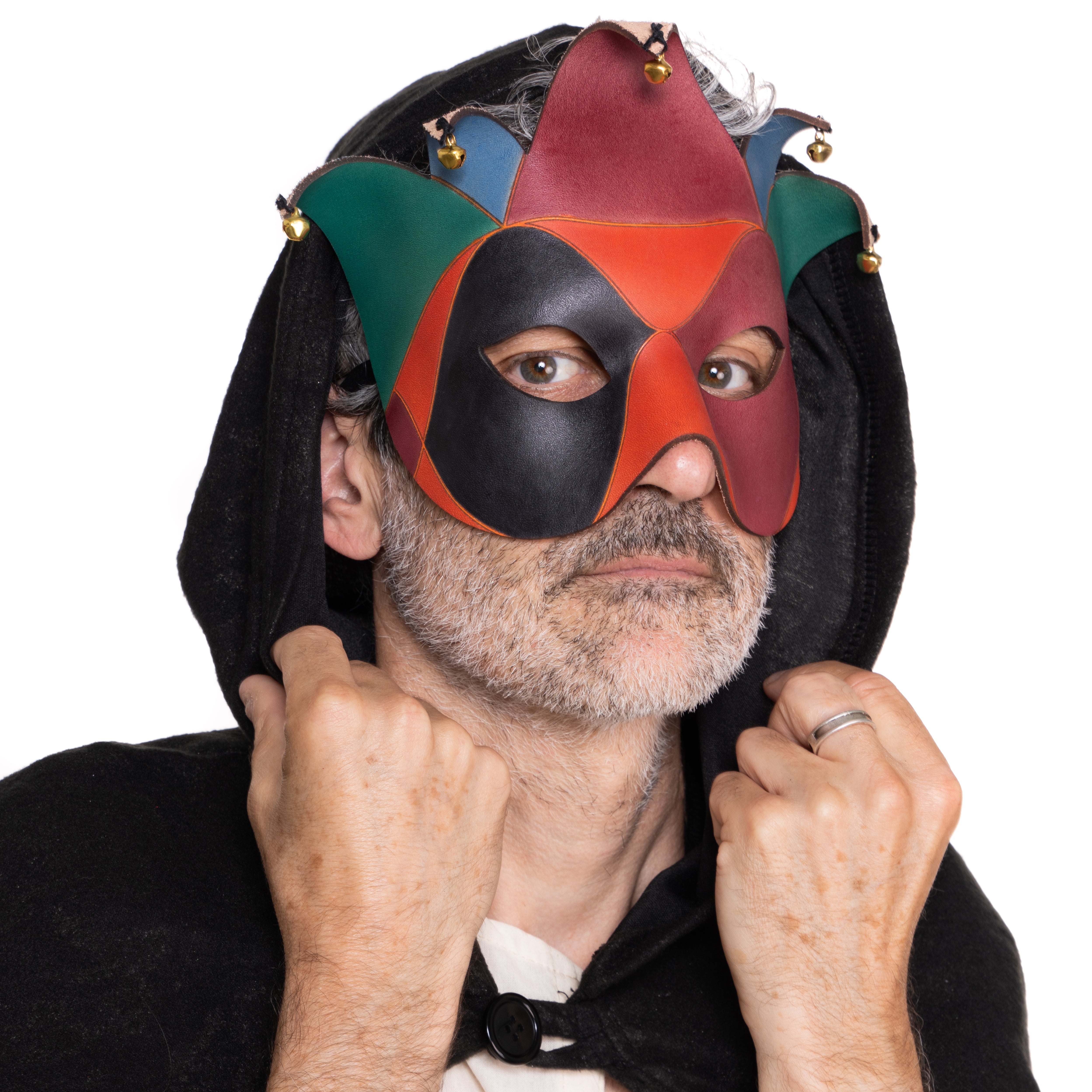
The jester's cap is an iconic head covering closely associated with the figure of the fool, rogue, or court jester. Its most characteristic form is that of a cap with several points or spikes , often adorned with small bells. The jester's cap originated in Europe during the High Middle Ages (around the 11th century) , where it served as a symbol of recognition for professional court jesters. It was meant to symbolize their special status, their license to criticize, and their role as entertainers.
The jester's cap experienced its heyday and widespread use in the Late Middle Ages (approx. 14th to 15th centuries) and the Early Modern period (approx. 16th to 17th centuries) . Today, the jester's cap is primarily present as a festive attribute in Carnival and Mardi Gras , where it represents the exuberance and suspension of social norms during this time.
♦ The coif

The coif was widespread throughout Europe from the 12th to the 15th centuries . It was a simple, close-fitting cloth cap, usually made of linen. Its main function was to cover and tame the hair, but it also served as padding under helmets.
It was worn by all social classes, from peasants to knights, making it one of the most fundamental head coverings of the Middle Ages.
♦ The Giver and the Veil

The bonnet and the chin strap were the most typical head coverings for married women throughout Europe from the 12th to the 14th centuries. The chin strap was a linen band worn tightly around the face and chin to completely cover the hair.
A veil was usually worn over it, often simple, but also elaborately draped or embroidered. This combination symbolized chastity and steadfastness and was a clear sign of a woman's married status.
♦ The Bycocket Hat

The Bycocket hat was widespread in Europe during the 13th and 14th centuries and was distinguished by its unique shape with an often pointed, raised brim.
This fashionable headwear was primarily worn by nobles and members of the upper classes and was a symbol of elegance and status in the Middle Ages. This hat is especially famous thanks to Robin Hood, to whom it is attributed.
♦ The hood

The hood was one of the most common head coverings in Europe from the 13th to the 15th centuries . Originally, it was a type of hood-like collar attached to clothing to protect against cold and bad weather.
Later it evolved into an independent garment, and the hood was often fashionably placed over the shoulder, while the long tail (the sendel) was artfully wrapped.
♦ The cardinal's hat

The cardinal's hat , also known as a galero , is an imposing headdress symbolizing the rank of cardinal in the Roman Catholic Church. This wide, flat hat, typically bright red, is distinguished by its characteristic 15 tassels (30 in total) hanging from each side. Although the cardinal's hat has been in use since the Middle Ages , it has not been part of cardinals' daily attire since 1969. It now serves primarily as a heraldic symbol in coats of arms.
The cardinal's hat (galero) was first bestowed upon cardinals in 1245. This occurred during the Council of Lyon, when Pope Innocent IV placed a red silk hat on the heads of thirteen newly appointed cardinals. Originally, it served as a symbol of their rank and dignity.
♦ The Chaperone

The chaperon was the most fashionable head covering for men (and sometimes women) in Western Europe from the 14th to the 15th centuries . It evolved from the cowl, which was wrapped and draped in a particularly elaborate way.
With its striking bulge and hanging piece of fabric (the cornet), it was a clear sign of status and good taste in the late Middle Ages.
♦ The Escoffion

The escoffion was an imposing, often cone- or horseshoe-shaped headdress worn by women in the late 14th and early 15th centuries .
These elaborately draped creations, often made from strips of fabric and wire frames, gave their wearers a statuesque appearance and were an expression of wealth and social standing.
♦ The Caul or Crespine

The caul (sometimes also called crespine ) was an elaborate headdress for women, popular mainly in the late Middle Ages (around the 14th and 15th centuries) . It was a fine-mesh hairnet, often made of gold thread or silk, that enclosed the hair, which was rolled up or braided to the sides.
Sometimes these cauls were equipped with cylindrical or box-like elements on the sides and were additionally combined with a veil or roll, resulting in very voluminous and imposing silhouettes.
♦ The Hennin

The hennin was a particularly striking, cone- or tower-shaped headdress worn primarily by European noblewomen in the 15th century . Often several meters high and adorned with a veil, it symbolized high social status and was a defining element of late medieval women's fashion.
The hennin varied extremely in its form, material and quality; countless variations of this head covering were manufactured in the late Middle Ages.
Hats of the Renaissance and Baroque periods

♦ The beret

From the 15th century onward, the beret was a true symbol of the early modern period, worn by everyone from nobles to common soldiers. It represented education and art, but was also incredibly practical. In the 20th century , it experienced a revival as a military symbol and in artistic circles, particularly through French painters and revolutionaries. Its versatility has made it a timeless classic.
♦ The Tudor cap or bonnet

Besides the beret, various types of soft caps were common in the 16th century . These could be round, flat, or slightly balloon-shaped and were often decorated with feathers or brooches. They were less formal than the beret and were worn by various social classes.
The cap was to go on to enjoy enormous success in the following centuries, producing countless variations, and is probably the most popular hat shape today.
♦ The bonnet and the cap

From the 16th to the 18th centuries, bonnets and caps were the primary head covering for women of all social classes. From simple linen bonnets for peasant women to elaborately embroidered lace bonnets for noblewomen, they served to cover the hair and emphasize its volume.
Especially in the 17th and 18th centuries, they were often decorated with ribbons, ruffles and embroidery.
♦ The cavalier's hat (musketeer's hat)

The cavalier or musketeer hat is an iconic head covering closely associated with the European musketeers of the 17th century .
It is essentially a precursor to the tricorn hat, but it was often designed in a more opulent and distinctive style. It frequently featured decorative feathers, giving it a very pompous appearance.
♦ The tricorn hat

The tricorn hat dominated fashion from the late 17th to the 18th century and was the indispensable headwear of European nobility and military.
Its characteristic triangular shape resulted from the upturned brim, which was practical for wearing wigs and also allowed rain to run off. It is readily associated with the Age of Enlightenment, but also with the golden age of piracy.
Hats of the 18th century

♦ The barge

The bonnet was a very popular head covering for women from the late 18th to the late 19th century . Its wide, stiff brim framed the face like a tunnel. Often made of straw or fabric and elaborately decorated, it protected from the sun and was a symbol of feminine elegance of the time.
♦ The bicorn hat

The bicorn hat replaced the tricorn hat in the late 18th and early 19th centuries and is inextricably linked to personalities such as Napoleon Bonaparte.
Its distinctive boat shape allowed it to be worn either facing forward or sideways. It was particularly popular among military officers and high-ranking civilians, and represented an era of great political upheaval.
♦ The shako

The shako , popular from the late 18th to the mid-19th century , was the defining headgear of many European armies. This tall, cylindrical military hat made soldiers look very imposing and also offered a degree of protection.
It was often adorned with plumes, cockades and a parasol, and symbolized discipline and military power.
♦ The top hat

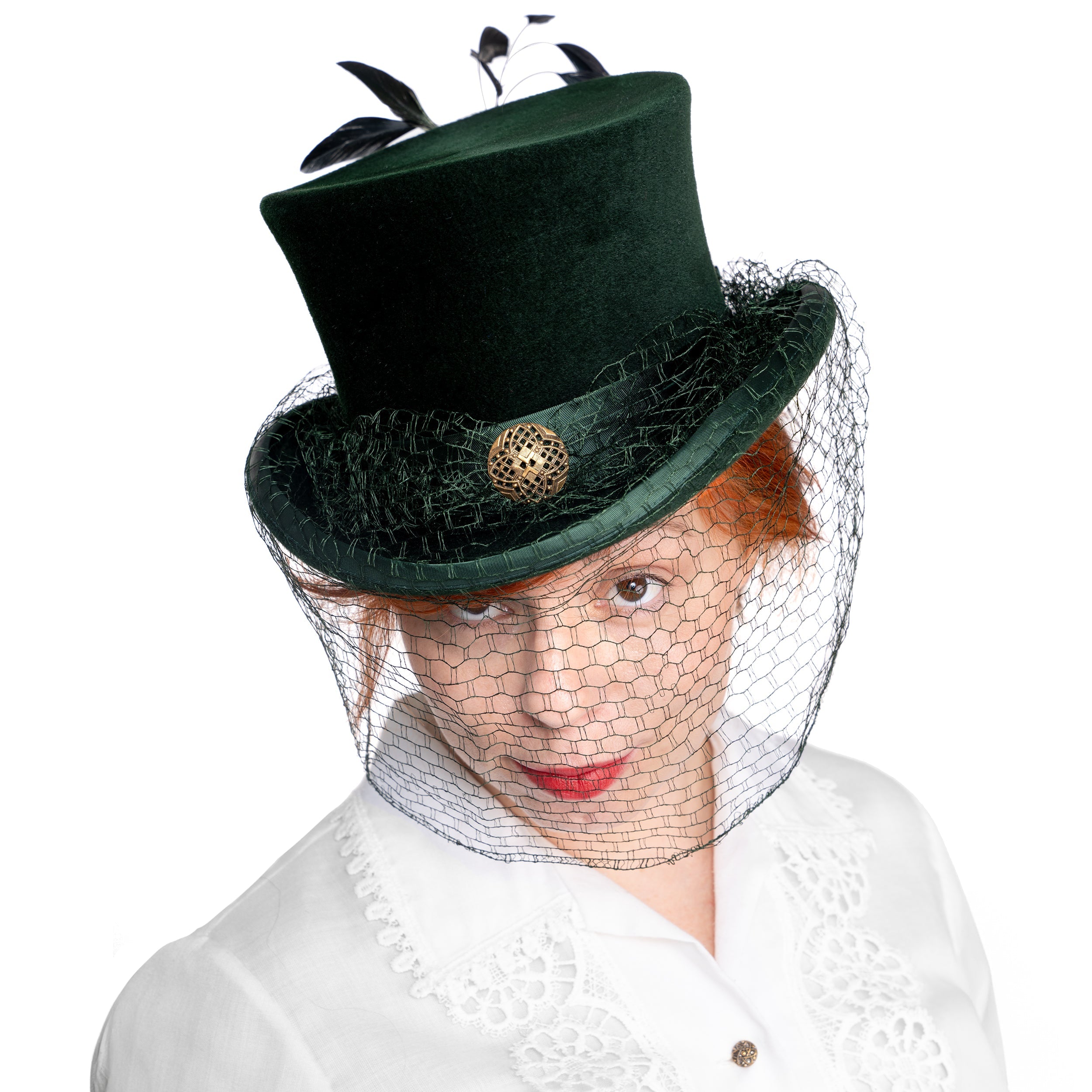
It's hard to believe, but the first precursors of the top hat can be found as early as the 16th century, but the top hat in its typical form was the epitome of formal elegance and status only from the 1790s to the 1930s .
It was a must-have for gentlemen of the upper and middle classes in major Western cities. Whether at the theater, social events, or in the office, the top hat exuded dignity and sophistication before being gradually replaced by more practical hats. Even today, it is still primarily worn by, for example, the English upper class, stage performers, or certain professions such as doormen or chimney sweeps.
♦ The pom-pom hat

The bobble hat became particularly popular in the 20th century, especially during the colder months and for winter sports. Originally often worn as a practical and warm head covering for sailors and laborers , it evolved into a popular leisure accessory. The pom-pom often served a very practical function, such as protecting sailors' heads from bumps on low ceilings.
Hats with pom-poms have been documented since the 18th century , for example among French sailors. The characteristic pom-pom on the top gives it a playful touch and made it particularly popular with children and teenagers.
Hats of modernity

♦ The Kepi

The kepi is a cylindrical or slightly conical military cap with a flat top and a fixed visor, typically worn by officers. It originated in France in the early 19th century and became the standard headgear of the army there.
The kepi spread rapidly to many other armies worldwide, particularly in the 19th and early 20th centuries , and is still part of many ceremonial and traditional uniforms today, especially well known from the American Civil War or the French Foreign Legion.
♦ Peaked cap

The peaked cap became established in the military sector from the early 19th century and then spread to civilian use from the late 19th century onwards.
It remains a staple in police, railway, and maritime uniforms to this day, and was increasingly worn informally and for sport in the 20th century. Its practical design with the protective visor makes it versatile and durable.
♦ The Calabrese or Hecker hat

The Calabrese hat was particularly popular in the first half of the 19th century . It is a felt hat for men with a very wide brim and a tall crown, sometimes pointed or rounded. It originated in Calabria, Italy, and was worn especially by Italian freedom fighters, the so-called Carbonari.
In Germany, this hat became a symbol of German revolutionaries around 1848. The Baden revolutionary Friedrich Hecker (1811–1881) wore this hat very prominently, which led to the style often being called the "Hecker hat" in Germany and thus becoming popular. Later, the shape and name were also adopted for fashionable women's straw hats.
♦ The Chapeau Claque cylinder

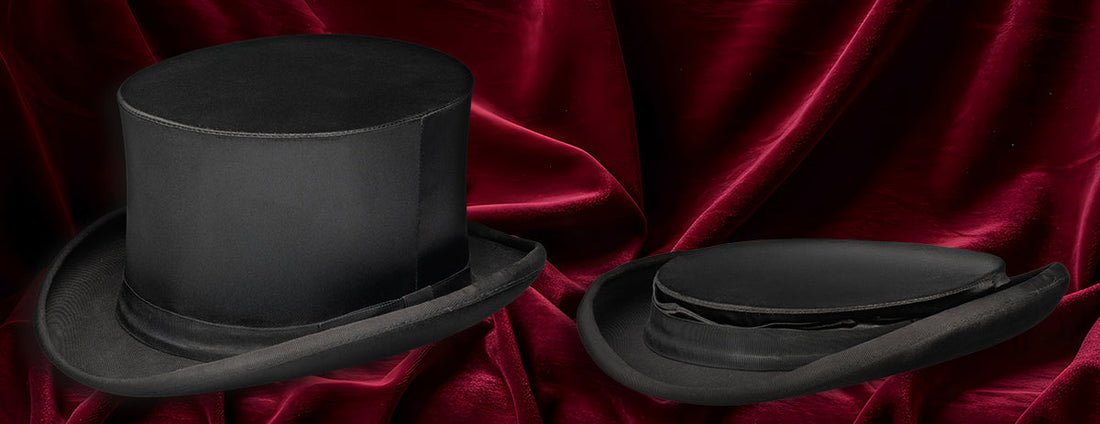
The chapeau claque , popular from the mid- 19th to the early 20th century , was a sophisticated collapsible top hat . It was specifically designed for evening events so that gentlemen could discreetly stow it under their seats.
This practical and elegant hat was an expression of social life and the pursuit of comfort in high society.
♦ Melon (Bowler Hat)

The bowler hat , popular from the mid-19th to the mid-20th century , was a symbol of both the British businessman and the working class. Robust, practical, yet stylish, it offered a less formal alternative to the top hat.
It achieved cult status through comedians like Charlie Chaplin and represented an era of industrial progress and social change.
♦ Cowboy hat

The cowboy hat , which originated in the mid-19th century , is the iconic symbol of the American West. The Stetson brand, in particular, is and remains inextricably linked to the cowboy hat.
It was designed to protect cowboys and ranchers from sun, wind, and rain, and quickly became a distinctive symbol of the pioneer era. Its wide brim and high crown are not only practical but also embody freedom and adventure.
♦ The Bolero Hat

The bolero hat is a flat, round hat shape with a straight brim and a low crown. It is closely associated with traditional Spanish dress, particularly that of the torero (bullfighter), where it is known as a "montera." Its origins date back to the 19th century , when it developed in Spain.
Beyond Spain, the bolero hat also found its way into fashion and became popular as a ladies' hat in the late 19th and early 20th centuries , often in combination with elegant suits. It exudes a certain drama and elegance and remains a symbol of Latin American culture and dance to this day. In Western films, the Bolero became iconic primarily through Clint Eastwood in "The Good, the Bad and the Ugly" .
♦ The baseball cap

The baseball cap started in the mid-19th century as purely sporting headwear and became a global everyday phenomenon from the late 20th century onwards.
Today, it's a casual statement piece and an indispensable accessory for everyone, combining comfort and coolness. Whether for sports, as a fashion statement, or for sun protection – its presence is ubiquitous. There are various modern styles of the baseball cap , such as the airy trucker cap , the flat dad hat , the aerodynamic cycling cap , or the snapback cap, which is very popular in hip hop.
♦ The boat cap

The sailor cap is a soft, foldable cap whose shape resembles a small boat or ship when worn. It originated in the 19th century and became a very popular and practical headgear in many armies worldwide during the 20th century , as it was easy to stow when not in use.
It is often worn diagonally on the head and remains a part of many military work and service uniforms to this day.
♦ The beanie or tube hat

The beanie , also known as a tube hat , is a close-fitting knitted hat without a brim, whose origins date back to the 19th century . Originally, the beanie was primarily a practical head covering for laborers , sailors , and fishermen who needed a warm, close-fitting hat that wouldn't slip and protected them from the cold while they worked.
The beanie gained increasing popularity in the 20th century , becoming a casual fashion accessory, especially during the colder months. In the late 20th and early 21st centuries, the beanie became a staple of streetwear and is now a universal symbol of informal style and comfort.
♦ The mountain cap (military cap)

The mountain cap became established from the second half of the 19th century and gained particular importance as military headgear in the early 20th century, especially for mountain troops in alpine regions.
It is made of wool, has a small brim, and served to protect against cold and weather. Its functional design made it an indispensable piece of equipment in difficult terrain.
♦ The beret

The Basque beret is a soft, flat cap (similar to the beret) that originated in the Basque Country and spread worldwide from the 19th century onwards.
With its timeless design, it is often associated with artists, intellectuals and the working class, but is also worn in the military as part of uniforms.
♦ The Fedora

The fedora enjoyed its heyday from the late 19th century until the 1960s and was the hat of the modern man. Its soft felt texture and characteristic indentation made it versatile for both formal and informal occasions.
Icons like Frank Sinatra and Indiana Jones shaped its cool and adventurous image, which still resonates today.
♦ The boater hat

The circular saw hat, sometimes also called a canotier hat , popular from the late 19th to the early 20th century, was the ultimate summer hat for gentlemen. With its stiff, flat crown and brim, it exuded an effortless elegance.
It was often seen at rowing parties, picnics, and as part of summer outfits, representing a carefree leisure culture.
♦ The Panama Hat

The Panama hat , popular since the late 19th century and a classic to this day, is the epitome of summer elegance. Handwoven from toquilla straw, it became world-famous during the construction of the Panama Canal.
It is lightweight, breathable and offers excellent sun protection, making it the ideal companion for him and her on warm days.
♦ The flat cap

The flat cap was the headwear of the working class and rural areas from the late 19th to the mid-20th century . Practical, warm, and unpretentious, it was worn by everyone from newspaper boys to factory workers.
With series like "Peaky Blinders", it experienced a major fashion comeback in the 21st century and today stands for a casual retro style.
♦ The newsboy cap

The balloon cap , also known as an eight-piece cap or newsboy cap , is a voluminous cap style that enjoyed great popularity from the late 19th century and especially in the early 20th century . Its name derives from the characteristic round and puffy crown , which is often made from eight fabric segments (similar to a cake tin) sewn together and fastened at the top center with a button.
It has a fixed, small brim and is typically worn loosely, giving it more volume than a flat cap. Originally often worn by newsboys, laborers, and athletes, it later became a fashionable accessory for men and women of all social classes.
♦ The serving hat

The turn-up hat was a popular women's headwear in the late 19th and early 20th centuries.
Its distinctive feature was the upturned brim , which elegantly framed the face. Often richly decorated with feathers and flowers, it was an expression of the opulent hat fashion of the time.
♦ The sun hat (broad brim)

The wide-brimmed sun hat has become an indispensable accessory for women and children during outdoor leisure activities since the late 19th century , but especially in the 20th century.
It effectively protects against the sun and was made from various materials such as straw, fabric, or synthetics. Its designs ranged from elegant, ornate models to simple, functional versions that prioritized comfort and protection.
♦ The Fascinator

A fascinator is a lightweight, often highly decorative head covering, typically worn at formal occasions such as weddings, horse races, or receptions.
It became popular from the late 19th century onwards , but experienced a strong resurgence particularly from the 1980s onwards as an alternative to large hats at occasions with a strict dress code.
♦ The Trilby

The trilby emerged in the early 20th century and was a popular alternative to the fedora, particularly in the 1960s. It is very similar to the fedora but has a shorter and often narrower brim that curves slightly downwards at the front and upwards at the back.
The crown of the trilby is usually also somewhat lower and often indented at the front. It became popular through its association with jazz musicians, intellectuals, and the Mod subculture, and remains a classic accessory to this day, combining elegance and casual style.
♦ The cloche hat

The cloche hat was a defining headwear item of the 1920s . It was close-fitting and bell-shaped, reaching low over the forehead and perfectly complementing the bob haircut of the time.
Mostly made of felt and often decorated, it symbolized the new freedom of the "flapper" era and remains an iconic accessory of the Art Deco era to this day.
♦ The Ushanka (Kolchakovka)

The ushanka , an iconic fur hat, originated in Russia and is known for its distinctive, fold-down ear flaps. These flaps can be tied under the chin to protect the ears and chin from extreme cold, or fastened high on the head. The ushanka, as we know it today and associate it with Russia, was introduced around 1940 as part of the Soviet Army's winter uniform.
Its direct predecessor was the so-called Kolchakovka , introduced by the White Army in 1918 during the Russian Civil War. The Ushanka is therefore a further development of this earlier form, optimized for the extreme Russian winters.
Modern and contemporary hats

♦ The aviator cap

The aviator cap originated in the early 20th century with the rise of aviation and quickly became indispensable headwear for pilots. It was characterized by its close fit, often made of leather, and its long ear flaps that could be fastened over the ears to protect against wind and cold in open cockpits.
It was often equipped with eyeglass straps or integrated aviator goggles. The aviator cap became a symbol of adventure, pioneering spirit, and the fascination of flying.
♦ The Pork Pie

The pork pie hut , whose origins lie in the 19th century , had its most popular phases in the 1920s and then again in the 1950s to 1980s.
Named for its resemblance to a pork pie, it's a statement hat often associated with artists, jazz musicians, and the ska subculture. Its distinctive, flat crown with the circular indentation gives it a unique look.
♦ The Pillbox Hat

The pillbox hat is a small, cylindrical hat without a brim, whose name comes from its resemblance to a pillbox.
It experienced a huge surge in popularity in the 1960s , significantly influenced by icons like Jackie Kennedy, who made it a symbol of understated elegance and modern style. Today, this hat is primarily seen on airline and railway staff.
♦ The docker cap (fisherman's cap)

The docker cap , also known as a fisherman's cap , is a close-fitting, often ribbed knitted cap with or without a very short brim, which became popular in the 20th century . It owes its name to its popularity among dockworkers and fishermen who needed a cap that kept them warm, stayed in place, and did not obstruct their vision.
It is typically worn so that the ears are covered, but the forehead remains exposed. The docker cap has evolved from purely workwear to a modern fashion accessory and today represents a casual, functional style.
♦ The fishing hat

The bucket hat , also known as a fisherman's hat or bob hat, experienced a real boom in the 20th century, especially in the 1980s and 1990s. Originally designed as a practical and weatherproof hat for anglers and farm workers, it found its way into hip-hop culture and became a fashion statement.
Its soft, downward-sloping brim and comfortable fit make it a versatile and casual hat for various occasions. It's also currently very fashionable again.